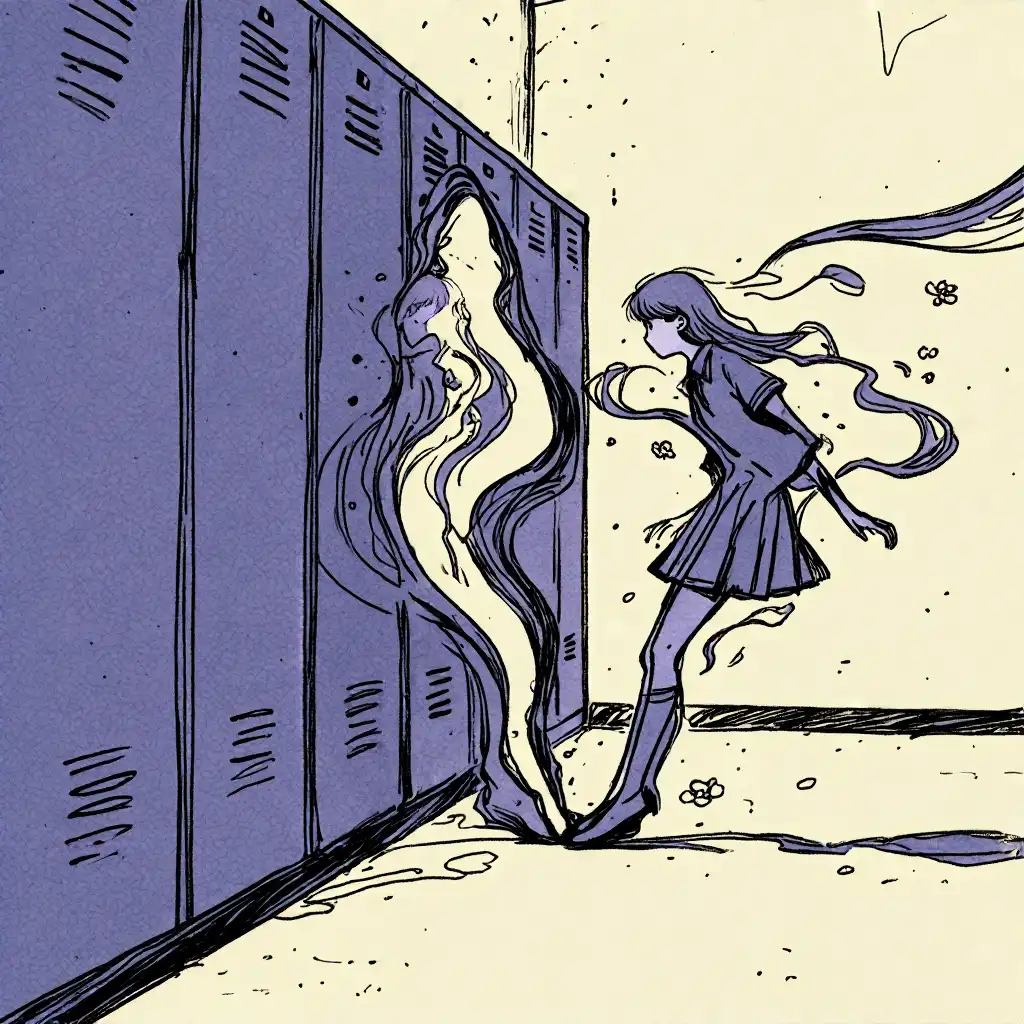
The hallway smells like floor wax and teenage fear.
Lin Mei walks through it like a ghost in her own memory. The lockers are the same blue. The lights are the same fluorescent buzz. The floor is the same scuffed linoleum that she once stared at for forty-five minutes during a fire drill because looking up meant meeting someone's eyes.
She knows this hallway. She has walked it a thousand times. In another life. In her real life. The life where she wore shoes with holes and ate lunch in the bathroom and learned that invisibility is a skill you can practice until it becomes indistinguishable from breathing.
But this time she is different.
This time her uniform fits. This time her shoes are new. This time she walks with her shoulders back because this body's mother taught her how to stand like she deserves the space she occupies.
She turns the corner.
And she sees her.
The girl is pressed against the lockers, trying to become part of the metal. Her uniform is too big. Her hair is falling in her face. Her arms are wrapped around her books like they are the only things keeping her from floating away.
Lin Mei stops walking.
She knows that posture. She knows that fear. She knows the exact temperature of that metal against her back, the way it steals heat through thin fabric, the way it becomes a kind of comfort because at least the lockers don't have opinions.
The girl is her.
Not metaphorically. Not poetically. The girl is her. The real her. The original her. The her that lived through every day of this hell and never once complained because complaining requires someone to complain to, and she had no one.
Lin Mei stands in the middle of the hallway and forgets how to breathe.
A group of students passes between them. Laughing. Shouting. Alive in the careless way that only people who have never been afraid can be. They block Lin Mei's view for three seconds. Three seconds that feel like three years.
When they pass, the girl is still there. Still pressed against the lockers. Still invisible.
Lin Mei takes a step forward. Then another. Her new shoes make no sound on the linoleum. Her new body moves with a confidence that feels borrowed, stolen, wrong.
She stops three feet away from the girl.
The girl doesn't look up. Of course she doesn't. Looking up means acknowledging that someone is there, and acknowledging that someone is there means they might notice you back, and being noticed is the first step toward being hurt.
Lin Mei opens her mouth. She doesn't know what to say. She has rehearsed this moment a thousand times in her head, in the factory, in the dormitory, in the dark hours before sleep. She has imagined what she would say to her younger self if she ever got the chance.
She imagined wisdom. She imagined comfort. She imagined the perfect words that would unlock everything, that would change everything, that would save everything.
What comes out is: "Your shoelace is untied."
The girl looks down. Her shoelace is not untied. It is tied in a careful double knot, the kind of knot that poor kids learn because they can't afford new laces if the old ones break.
The girl looks up. Her eyes are brown. The same brown as Lin Mei's. The same brown as the earth in the factory courtyard where Lin Mei used to eat her lunch alone, watching the smoke rise from the chimneys and wondering if this was all there was.
"What?" The girl's voice is barely audible. A whisper wrapped in a question wrapped in fear.
"Nothing," Lin Mei says. "Sorry. I thought. Never mind."
She walks away. Her hands are shaking. Her heart is hammering against her ribs like a bird trying to escape a cage.
She walks to the end of the hallway. She turns the corner. She leans against the wall and slides down until she is sitting on the floor, knees pulled to her chest, forehead pressed against her knees.
She is crying. She doesn't know when she started. The tears are hot and silent and they taste like every day she ever spent in this building, every minute she ever spent pressed against those lockers, every second she ever spent wishing she was someone else.
She cries until the bell rings. Then she wipes her face with her sleeve. She stands up. She smooths her uniform. She walks to class.
She does not look back.
But she knows. She knows with a certainty that settles in her bones like winter.
She is not leaving that girl alone.
Not this time.
Not ever.
走廊闻起来像地板蜡和青少年的恐惧。
林梅穿过它,像穿过自己记忆中的幽灵。储物柜是同样的蓝色。灯是同样的荧光灯嗡嗡声。地板是同样的磨损亚麻地板,她曾经在一次消防演习中盯着它看了四十五分钟,因为抬头意味着与某人的目光相遇。
她认识这条走廊。她走过一千次。在另一个生活里。在她真实的生活里。那个她穿着破洞的鞋子、在厕所里吃午饭、学会隐形是一种可以练习到与呼吸无法区分的技能的生活里。
但这次她不同了。
这次她的校服合身。这次她的鞋子是新的。这次她走路时肩膀向后,因为这个身体的母亲教过她如何站得像她值得占据的空间一样。
她转过拐角。
然后她看到了她。
那个女孩紧贴着储物柜,试图成为金属的一部分。她的校服太大了。她的头发垂在脸上。她的手臂抱着书,好像它们是唯一阻止她飘走的东西。
林梅停下脚步。
她认识那个姿势。她认识那种恐惧。她认识那种金属贴在背上的确切温度,它如何透过薄布料偷走热量,它如何成为一种安慰,因为至少储物柜没有意见。
那个女孩是她。
不是比喻。不是诗意。那个女孩是她。真实的她。原来的她。那个经历过这种地狱的每一天、从未抱怨过的她,因为抱怨需要有人可以抱怨,而她没有人。
林梅站在走廊中间,忘记了如何呼吸。
一群学生从她们之间走过。笑着。喊着。以只有从未害怕过的人才能拥有的那种不经意的方式活着。她们挡住了林梅的视线三秒钟。三秒钟感觉像三年。
当她们走过时,那个女孩还在那里。仍然紧贴着储物柜。仍然隐形。
林梅向前迈了一步。又一步。她的新鞋子在亚麻地板上无声。她的新身体带着一种借来的、偷来的、错误的自信移动。
她在离女孩三英尺的地方停下来。
女孩没有抬头。当然她没有。抬头意味着承认有人在那里,承认有人在那里意味着他们可能会注意到你,被注意到是受伤的第一步。
林梅张开嘴。她不知道说什么。她在脑海中排练过这一刻一千次,在工厂里,在宿舍里,在睡前的黑暗时刻。她想象过如果有机会,她会对年轻的自己说什么。
她想象过智慧。她想象过安慰。她想象过完美的词语,可以解锁一切,改变一切,拯救一切。
说出来的是:"你的鞋带松了。"
女孩低下头。她的鞋带没有松。它系着一个仔细的双结,那种穷孩子学会的结,因为如果旧鞋带断了,她们买不起新的。
女孩抬起头。她的眼睛是棕色的。和林梅一样的棕色。和工厂院子里泥土一样的棕色,林梅曾经独自在那里吃午饭,看着烟囱里冒出的烟,想这就是全部了吗。
"什么?"女孩的声音几乎听不见。一个包裹在问题里的耳语,包裹在恐惧里。
"没什么,"林梅说。"对不起。我以为。没关系。"
她走开了。她的手在抖。她的心像试图逃离笼子的鸟一样撞击着肋骨。
她走到走廊尽头。她转过拐角。她靠着墙滑下去,直到坐在地板上,膝盖抱在胸前,额头压在膝盖上。
她在哭。她不知道什么时候开始。眼泪是热的、无声的,它们尝起来像她在这栋楼里度过的每一天,她紧贴着那些储物柜的每一分钟,她希望自己成为别人的每一秒钟。
她哭到铃声响起。然后她用袖子擦脸。她站起来。她抚平校服。
她走向教室。
她没有回头。
但她知道。她知道一种像冬天一样 settle 在骨头里的确定性。
她不会留下那个女孩一个人。
这次不会。
永远不会。