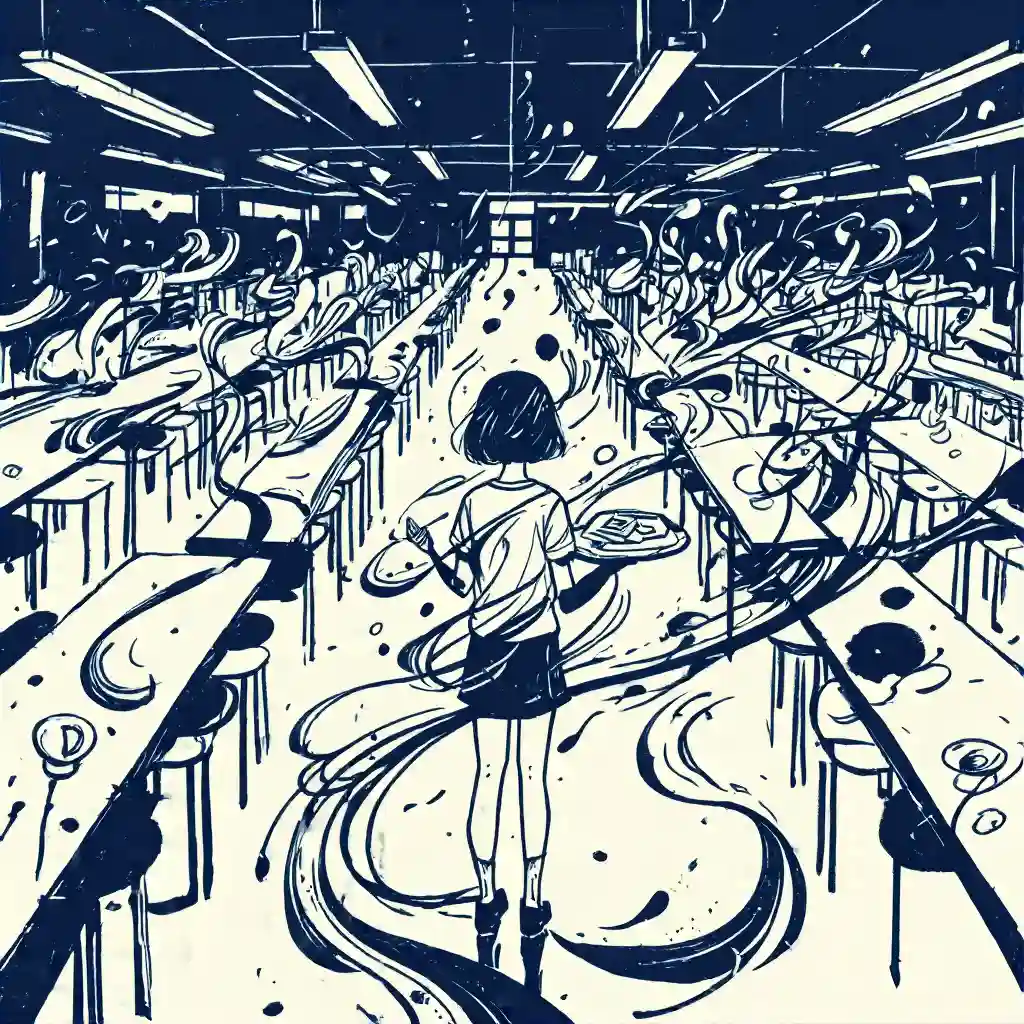
The cafeteria is a battlefield.
Lin Mei knows this. She has known this since she was sixteen. The first time. The real time. She knows the geography of fear: which tables are safe, which tables are traps, which tables exist in the neutral zone where no one sits because sitting there means admitting you have nowhere else to go.
She walks in with her new tray. Her new uniform. Her new confidence that sits on her skin like a coat that doesn't quite fit.
She scans the room.
Wang Fang is at the center table, surrounded by her planets. They are eating sushi again. Actual sushi, delivered in wooden boxes with red ribbons. Wang Fang picks up a piece, examines it, puts it down. Too much rice. Not enough fish. Someone else finishes it.
Lin Mei looks away. She is not here for Wang Fang. She is here for the girl in the corner.
The girl is alone. Of course she is alone. She is always alone. She sits at the table near the trash cans, the one where the smell of old food mingles with the sound of two hundred teenagers shouting over each other. She is eating a steamed bun and pickled vegetables from a jar that used to hold peanut butter.
Lin Mei recognizes the jar. She recognizes the pickles. She recognizes the way the girl holds the bun with both hands, like someone might take it from her, like food is something that can be stolen at any moment.
She walks toward the table.
The girl doesn't look up. She is focused on her bun. She is counting the seconds until she can leave. Lin Mei knows this because she used to count too. Six minutes. That was her number. Six minutes was long enough to be noticed but short enough to avoid conversation.
Lin Mei sits down.
The chair scrapes against the floor. The sound is loud. Too loud. The girl flinches. Her shoulders curl inward. Her body tries to make itself smaller, a movement Lin Mei recognizes from the inside. She spent forty-two years making herself smaller.
"Hi," Lin Mei says.
The girl says nothing. She takes a bite of her bun. It is a small bite. A careful bite. The bite of someone who has learned that food is finite and must be rationed, even when it is not.
"I'm Lin Mei," she says. "The new girl. Well. New to this school. Not new to. Never mind."
The girl looks up. Her eyes are the same brown. The same brown as the earth in the factory courtyard. The same brown as Lin Mei's own eyes, reflected back at her from a face that is younger and softer and more afraid.
"I know who you are," the girl says. Her voice is barely audible. "Everyone knows who you are."
"Oh." Lin Mei didn't expect this. She didn't expect to be known. In her first life, no one knew who she was. She was a ghost with a student ID number. "Is that. Good? Or bad?"
The girl shrugs. It is a small shrug, a defeated shrug, the shrug of someone who has learned that opinions don't matter because no one asks for them.
"I don't know," the girl says. "I don't pay attention to things like that."
She is lying. Lin Mei knows she is lying. She used to say the same thing. I don't pay attention. I don't care. It doesn't matter. All lies. All armor. All ways of protecting a heart that was already broken.
"You write poetry," Lin Mei says.
It is not a question. It is a statement. A fact. A piece of knowledge that Lin Mei has carried for twenty-six years, since she found the notebook buried in a box of old clothes and read the words of a girl who believed in secrets and the possibility of being seen.
The girl freezes. Her bun is halfway to her mouth. Her eyes are wide. Her fear is visible now, raw and exposed, like a wound that has been uncovered.
"How." The girl swallows. "How do you know that?"
"I know a lot of things," Lin Mei says. She tries to make her voice gentle. She doesn't know if she succeeds. Gentleness is a skill she never learned. In the factory, gentleness got you nothing. In the dormitory, gentleness got you taken advantage of. In her life, gentleness was a luxury she could not afford.
"I don't." The girl shakes her head. "I don't write poetry. That's. That's stupid."
"It's not stupid," Lin Mei says. "It's the opposite of stupid. It's the bravest thing you can do. Writing words that no one will read. Believing they matter anyway. That's not stupid. That's."
She stops. She doesn't know the word. She has never known the word. In her first life, she would have said it was pointless. In her first life, she would have been wrong.
"That's what?" the girl asks.
"That's hope," Lin Mei says. "And hope is the only thing that ever saved anyone."
The girl looks at her. Really looks at her. For the first time. Her eyes travel from Lin Mei's new shoes to her new uniform to her new face that is somehow, impossibly, her own face.
"You're weird," the girl says.
"I know," Lin Mei says. "But I'm also right."
The girl almost smiles. It is not a real smile. It is the ghost of a smile, the memory of a smile, the promise of a smile that might one day become real if someone is patient enough to wait for it.
"What do you want?" the girl asks. "Why are you talking to me?"
Lin Mei looks at her. At this girl who is her and is not her. At this girl who carries all the same fears, all the same dreams, all the same words hidden in a notebook under her mattress.
"I want to be your friend," Lin Mei says. "I know that sounds. I know that sounds like something people say before they hurt you. But I mean it. I really mean it."
The girl looks down at her bun. It is cold now. The pickles are sour. She eats them anyway, because food is food and hunger doesn't care about hope.
"Okay," the girl says. "But if you're lying, I'll know."
"I know you will," Lin Mei says. "You're smarter than you think."
The girl looks up. Her eyes are different now. Not less afraid. But afraid and something else. Something that might, one day, become trust.
"What's your name?" Lin Mei asks. "Your real name. Not what they call you."
The girl is quiet for a long time. The cafeteria noise swirls around them. Two hundred teenagers shouting over each other, living lives that have nothing to do with this table, this moment, this impossible conversation.
"Mei," the girl says. "Lin Mei."
"I know," Lin Mei says. "I know."
She reaches across the table. She touches the girl's hand. It is cold. It is small. It is her own hand, twenty-six years ago, before the factory, before the dormitory, before the rain.
"I'm going to call you Little Mei," Lin Mei says. "Is that okay?"
The girl. Little Mei. Looks at her. Really looks at her.
"Okay," she says. "But only if you tell me why you're crying."
Lin Mei touches her face. Her fingers come away wet. She didn't know she was crying. She didn't know her body could still produce tears. She thought she used them all up in the hospital, holding her mother's hand, telling lies about everything being okay.
"I'm not crying," Lin Mei says. "I'm just. I'm just happy to meet you."
Little Mei looks at her for a long time. The cafeteria noise fades. The world shrinks to this table, this touch, this impossible moment where two versions of the same person sit across from each other and try to figure out what comes next.
"You're a terrible liar," Little Mei says.
"I know," Lin Mei says. "But I'm working on it."
食堂是战场。
林梅知道这一点。她从十六岁起就知道。第一次。真实的那次。她了解恐惧的地理:哪些桌子是安全的,哪些桌子是陷阱,哪些桌子存在于中立区,没有人坐在那里,因为坐在那里意味着承认你没有其他地方可去。
她端着她的新托盘走进来。她的新校服。她的新自信,像一件不太合身的外套一样坐在她的皮肤上。
她扫视房间。
王芳坐在中间的桌子旁,被她的行星围绕。她们又在吃寿司。真正的寿司,装在系着红丝带的木盒里送来的。王芳夹起一块,端详了一下,放下了。米饭太多。鱼太少。别人把它吃完。
林梅移开目光。她不是为王芳而来的。她是为角落里的女孩而来的。
那个女孩独自一人。当然她独自一人。她总是独自一人。她坐在靠近垃圾桶的桌子旁,那张旧食物的气味和两百个青少年互相叫喊的声音混在一起的桌子。她正在吃一个馒头和从一个曾经装花生酱的罐子里拿出来的腌菜。
林梅认识那个罐子。她认识那些腌菜。她认识那个女孩用双手拿着馒头的方式,好像有人可能从她那里抢走它,好像食物是随时可能被偷走的东西。
她走向那张桌子。
女孩没有抬头。她专注于她的馒头。她在数秒数,直到她可以离开。林梅知道这一点,因为她以前也数过。六分钟。那是她的数字。六分钟足够被注意到,又足够短到避免交谈。
林梅坐下来。
椅子刮过地板。声音很大。太大了。女孩退缩了。她的肩膀向内卷曲。她的身体试图让自己变小,一个林梅从内部认识的动作。她花了四十二年让自己变小。
"嗨,"林梅说。
女孩什么也没说。她咬了一口馒头。是一小口。一口仔细的。一个学会了食物是有限的、必须配给的人的口,即使它不是。
"我是林梅,"她说。"新来的女孩。嗯。新来这个学校的。不是新来的。没关系。"
女孩抬起头。她的眼睛是同样的棕色。和工厂院子里泥土一样的棕色。和林梅自己的眼睛一样的棕色,从一个更年轻、更柔软、更害怕的脸上反射回来。
"我知道你是谁,"女孩说。她的声音几乎听不见。"每个人都知道你是谁。"
"哦。"林梅没想到这一点。她没想到会被知道。在她的第一次生命中,没有人知道她是谁。她是一个带有学生证号码的幽灵。"那是。好的?还是坏的?"
女孩耸耸肩。那是一个小耸肩,一个被打败的耸肩,一个学会了意见不重要因为没有人问它们的人的耸肩。
"我不知道,"女孩说。"我不注意那种事情。"
她在撒谎。林梅知道她在撒谎。她以前也说过同样的话。我不注意。我不在乎。没关系。都是谎言。都是盔甲。都是保护一颗已经破碎的心的方式。
"你写诗,"林梅说。
这不是一个问题。这是一个陈述。一个事实。一个林梅已经携带了二十六年的知识,自从她在一箱旧衣服里发现笔记本,读了一个相信秘密和被看见的可能的女孩的文字。
女孩僵住了。她的馒头在半路上。她的眼睛睁大了。她的恐惧现在可见了,原始而暴露,像一个被揭开的伤口。
"你怎么。"女孩咽了咽。"你怎么知道的?"
"我知道很多事情,"林梅说。她试图让她的声音温柔。她不知道她是否成功了。温柔是她从未学会的技能。在工厂里,温柔什么也得不到。在宿舍里,温柔会让你被利用。在她的生活中,温柔是她负担不起的奢侈品。
"我不。"女孩摇了摇头。"我不写诗。那是。那是愚蠢的。"
"不愚蠢,"林梅说。"那是愚蠢的反面。你能做的最勇敢的事情。写没有人会读的文字。相信它们仍然重要。那不是愚蠢。那是。"
她停了下来。她不知道那个词。她从来不知道那个词。在她的第一次生命中,她会说这是没有意义的。在她的第一次生命中,她会是错的。
"那是什么?"女孩问。
"那是希望,"林梅说。"而希望是唯一曾经拯救过任何人的东西。"
女孩看着她。真的看着她。第一次。她的目光从林梅的新鞋子移到她的新校服,移到她的新脸,那张不知何故,不可能地,是她自己的脸。
"你很奇怪,"女孩说。
"我知道,"林梅说。"但我也没错。"
女孩几乎笑了。这不是一个真正的微笑。它是一个微笑的幽灵,一个微笑的记忆,一个微笑的承诺,如果有一天有人足够耐心等待它,它可能会变成真实的。
"你想要什么?"女孩问。"你为什么和我说话?"
林梅看着她。看着这个既是她又不是她的女孩。看着这个承载着所有同样的恐惧、所有同样的梦想、所有同样的文字藏在床垫下的笔记本里的女孩。
"我想成为你的朋友,"林梅说。"我知道那听起来。我知道那听起来像人们在伤害你之前会说的话。但我是认真的。我真的是认真的。"
女孩低头看着她的馒头。它现在凉了。腌菜是酸的。她还是吃了,因为食物就是食物,饥饿不在乎希望。
"好吧,"女孩说。"但如果你在撒谎,我会知道的。"
"我知道你会的,"林梅说。"你比你想象的更聪明。"
女孩抬起头。她的眼睛现在不同了。不是不那么害怕。而是害怕和别的东西。那种有一天可能变成信任的东西。
"你叫什么名字?"林梅问。"你的真名。不是她们叫你的那个。"
女孩沉默了很长时间。食堂的噪音在她们周围旋转。两百个青少年互相叫喊,过着与这张桌子、这个时刻、这次不可能的对话无关的生活。
"梅,"女孩说。"林梅。"
"我知道,"林梅说。"我知道。"
她伸过桌子。她触摸女孩的手。它是冷的。它是小的。它是她自己的手,二十六年前,在工厂之前,在宿舍之前,在雨之前。
"我要叫你小梅,"林梅说。"可以吗?"
女孩。小梅。看着她。真的看着她。
"好吧,"她说。"但只有你告诉我你为什么哭。"
林梅触摸她的脸。她的手指湿了。她不知道她在哭。她不知道她的身体还能产生眼泪。她以为她在医院里用光了它们,握着母亲的手,对一切都会好起来的谎言。
"我没哭,"林梅说。"我只是。我只是很高兴见到你。"
小梅看了她很长时间。食堂的噪音消失了。世界缩小到这张桌子,这个触摸,这个两个版本的同一个人坐在对面,试图弄清楚接下来会发生什么的不可能的时刻。
"你是个糟糕的撒谎者,"小梅说。
"我知道,"林梅说。"但我在努力。"