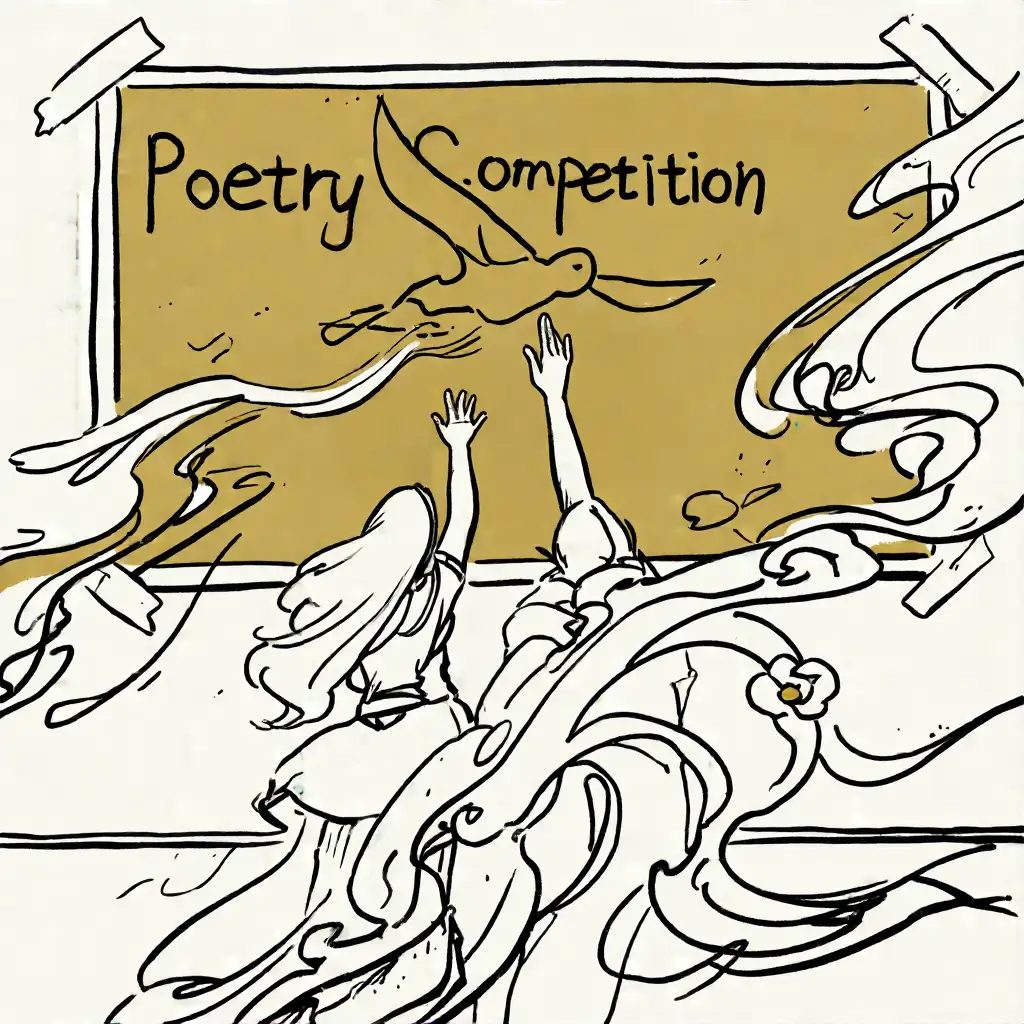
The poetry competition flyer is taped to the bulletin board.
Lin Mei sees it first. She is walking Little Mei to class, a habit that has become something else, something that neither of them has named, something that exists in the space between friendship and family and the impossible bond of being the same person twice.
She stops in front of the board.
"What?" Little Mei asks.
"This," Lin Mei says. She points to the flyer. "You should enter."
Little Mei looks at the flyer. Her eyes scan the words. Poetry Competition. Open to all students. First prize: publication in the school literary magazine. A chance to be seen. A chance to be heard. A chance to matter.
"No," Little Mei says. Her voice is small. Her voice is certain. "I can't."
"Why not?"
"Because." Little Mei looks at the floor. She looks at her shoes. She looks at everything except the flyer. "Because I'm not good enough. Because people will laugh. Because."
"Because you're afraid," Lin Mei says. "Because being seen means being judged. Because putting your words out there means letting people inside your head. Because hope is terrifying and you would rather be invisible than be disappointed."
Little Mei is quiet. The hallway is quiet. The world is quiet.
"Yes," she says. "All of that."
"I know," Lin Mei says. "I know because I felt all of that. I felt it every day of my life. I felt it when I hid my poems. I felt it when I ate lunch alone. I felt it when I walked through the world like a ghost, convinced that I was nothing, that I would never be anything, that the best I could hope for was to survive."
"And you were wrong," Little Mei says.
"I was wrong," Lin Mei agrees. "But I didn't know I was wrong. I died not knowing I was wrong. I died thinking that my poems were stupid and my dreams were pointless and my life didn't matter. And I was wrong. I was so wrong. And I don't want you to die wrong."
Little Mei looks at the flyer. She touches the edge of the paper. Her fingers are shaking.
"What if they hate it?" she asks.
"What if they love it?" Lin Mei asks back.
"What if I'm not ready?"
"What if you are?"
Little Mei is quiet. The hallway fills with students. Laughing. Shouting. Living. They pass around the two girls who are standing in front of the bulletin board, staring at a flyer like it holds the answer to everything.
"What if I do it and nothing changes?" Little Mei asks. "What if I do it and I'm still invisible? What if I do it and no one cares?"
"Then you'll know," Lin Mei says. "You'll know that you tried. That you were brave. That you put your words into the world and let them breathe. And that matters. That matters more than any prize. More than any publication. More than any applause."
"Does it?" Little Mei asks. "Does it really matter if no one sees it?"
"It matters because you see it," Lin Mei says. "It matters because you wrote it. It matters because it exists, and it exists because you made it exist, and that is the most powerful thing any person can do. To create something from nothing. To make beauty out of pain. To say: I was here. I felt this."
Little Mei looks at her. Her eyes are brown. The same brown as the earth. The same brown as hope.
"When is it?" she asks.
"Next Friday," Lin Mei says. "You have a week."
"A week," Little Mei repeats. "To write something worth reading."
"You already have something worth reading," Lin Mei says. "You have a notebook full of poems that are better than anything I've ever read. And I've read a lot. I've had twenty-six years to read."
Little Mei almost smiles. It is not a real smile. But it is closer than before.
"Okay," she says. "I'll do it. But you have to help me."
"I'll help you," Lin Mei says. "But I won't write it for you. This has to be yours. Every word. Every line. Every tear."
"Every tear?"
"Every tear," Lin Mei says. "The best poems are written in tears."
The week passes like water.
Little Mei writes. She writes in the morning, before school. She writes at lunch, ignoring her food. She writes at night, after her mother falls asleep, by the light of a streetlamp that filters through the window.
She writes about the factory smoke. She writes about the peanut butter jar. She writes about the scar on her knee that is shaped like a crescent moon. She writes about the girl who sits across from her at lunch and cries when she thinks no one is watching.
She writes about fear. She writes about hope. She writes about the impossible space between what was and what could be.
Lin Mei reads every draft. She doesn't edit. She doesn't change. She just reads. And sometimes, she cries.
"This is good," she says. "This is better than good. This is true."
"True is scary," Little Mei says.
"True is everything," Lin Mei says. "True is the only thing that matters."
Friday arrives.
The auditorium is full. Students sit in rows. Teachers stand at the back. Wang Fang is in the front row, surrounded by her planets, her face a careful mask of indifference.
Little Mei is backstage. Her hands are shaking. Her stomach is twisting. Her heart is hammering against her ribs.
"I can't do this," she says. "I can't. I'm going to be sick."
"You can do this," Lin Mei says. She is standing behind her, hands on her shoulders, grounding her, holding her. "You have done harder things. You have survived worse things. You have lived through every day of a life that tried to break you, and you are still here. Still standing. Still fighting. This is just words. Just words on a page. And they are your words. And they are beautiful."
"What if I forget?" Little Mei asks. "What if I freeze? What if."
"Then I'll be there," Lin Mei says. "In the audience. Right in the front. And if you forget, you look at me. And I'll remind you. I'll mouth the words. I'll be your memory. I'll be your courage. I'll be whatever you need."
"Why?" Little Mei asks. "Why are you doing all this?"
"Because you matter," Lin Mei says. "Because your words matter. Because the world needs to hear what you have to say. And because I love you. I love you in a way that doesn't make sense, in a way that crosses time and space and life and death. I love you because you are me, and I am you, and we are the same person trying to save each other."
Little Mei turns. She looks at Lin Mei. Really looks at her.
"I love you too," she says. "Even though you're crazy. Even though this is impossible. Even though I still don't understand. I love you."
"Then go," Lin Mei says. "Go and show them who you are."
Little Mei walks onto the stage.
The lights are bright. The audience is quiet. The world is watching.
She stands at the microphone. She looks at the paper in her hands. She looks at the words she has written. She looks at the truth she has dared to tell.
Then she looks up. She looks at the front row. She looks at Lin Mei.
Lin Mei smiles. It is a real smile. A proud smile. A smile that says: you are enough. You have always been enough.
Little Mei takes a breath. She begins to read.
"I am invisible," she says. "I have been invisible for sixteen years. I have walked through hallways like a ghost. I have eaten lunch alone. I have written poems that no one reads and dreamed dreams that no one sees. I have been nothing. I have been nobody. I have been a waste of space and air and life."
The audience is quiet. The auditorium is quiet. The world is quiet.
"And then someone saw me," she continues. "Someone who shouldn't exist. Someone who knows my fears and my dreams and my poems. Someone who looks at me and sees not what I am, but what I could be. Someone who believes in me when I don't believe in myself."
She looks at Lin Mei. Her eyes are wet. Her voice is steady.
"This poem is for her. For the person who taught me that invisible is not the same as unimportant. That quiet is not the same as weak. That being seen is not about being perfect. It's about being real."
She takes a breath. She reads the poem.
It is about a girl who writes in the dark. It is about a jar that holds pickles and memories. It is about a scar shaped like the moon. It is about hope, fragile and fierce and impossible to kill.
When she finishes, the auditorium is silent. For three seconds. For five. For ten.
Then someone claps. One person. Two. Ten. The whole room.
Little Mei stands on the stage, tears streaming down her face, and for the first time in her life, she is not invisible.
She is seen.
诗歌比赛的传单贴在布告栏上。
林梅先看到它。她正送小梅去教室,一个已经成为别的东西的习惯,一种介于友谊和家庭和作为同一个人两次的不可能纽带之间的东西。
她在布告栏前停下来。
"什么?"小梅问。
"这个,"林梅说。她指着传单。"你应该参加。"
小梅看着传单。她的眼睛扫过文字。诗歌比赛。对所有学生开放。一等奖:在校文学杂志上发表。一个被看见的机会。一个被听到的机会。一个重要的机会。
"不,"小梅说。她的声音很小。她的声音很确定。"我不能。"
"为什么不能?"
"因为。"小梅看着地板。她看着她的鞋子。她看着一切,除了传单。"因为我不够好。因为人们会笑。因为。"
"因为你害怕,"林梅说。"因为被看见意味着被评判。因为把你的文字放出去意味着让人们进入你的头脑。因为希望是可怕的,你宁愿隐形也不愿失望。"
小梅安静了。走廊很安静。世界很安静。
"是的,"她说。"所有那些。"
"我知道,"林梅说。"我知道因为我感受到了所有那些。我每天都感受到了。我藏诗的时候感受到了。我独自吃午饭的时候感受到了。我像幽灵一样穿过世界的时候感受到了,确信我什么都不是,我永远不会成为什么,我能希望的最好结果是幸存。"
"而你错了,"小梅说。
"我错了,"林梅同意。"但我不知道我错了。我死时不知道我错了。我死时认为我的诗是愚蠢的,我的梦想是没有意义的,我的生活不重要。而我错了。我大错特错。而我不想你死时错了。"
小梅看着传单。她触摸纸的边缘。她的手指在颤抖。
"如果她们讨厌它呢?"她问。
"如果她们喜欢它呢?"林梅反问。
"如果我没准备好呢?"
"如果你准备好了呢?"
小梅安静了。走廊里充满了学生。笑着。喊着。活着。她们从站在布告栏前的两个女孩身边走过,盯着一张传单,好像它持有所有问题的答案。
"如果我做了,什么都没改变呢?"小梅问。"如果我做了,我仍然隐形呢?如果我做了,没人在乎呢?"
"那你会知道,"林梅说。"你会知道你尝试了。你很勇敢。你把你的文字放入世界,让它们呼吸。而那很重要。那比任何奖品都重要。比任何发表都重要。比任何掌声都重要。"
"真的吗?"小梅问。"如果没人看到,真的重要吗?"
"重要因为你看到了,"林梅说。"重要因为你写了它。重要因为它存在,它存在因为你让它存在,那是任何人能做的最有力的事情。从无到有创造东西。从痛苦中创造美。说:我在这里。我感受到了这个。我重要了。"
小梅看着她。她的眼睛是棕色的。和泥土一样的棕色。和希望一样的棕色。
"什么时候?"她问。
"下周五,"林梅说。"你有一周。"
"一周,"小梅重复。"写一些值得读的东西。"
"你已经有值得读的东西了,"林梅说。"你有一本笔记本,里面装满了比我读过的任何东西都好的诗。我读了很多。我有二十六年时间读书。"
小梅几乎笑了。这不是一个真正的微笑。但它比以前更接近了。
"好吧,"她说。"我会做的。但你要帮我。"
"我会帮你,"林梅说。"但我不会为你写。这必须是你的。每一个字。每一行。每一滴眼泪。"
"每一滴眼泪?"
"每一滴眼泪,"林梅说。"最好的诗是用眼泪写的。"
一周像水一样流逝。
小梅写。她在早上写,在学校之前。她在午饭时写,忽略她的食物。她在晚上写,在她母亲睡着之后,在透过窗户过滤进来的路灯的光下。
她写关于工厂烟。她写关于花生酱罐子。她写关于她膝盖上形状像新月的伤疤。她写关于坐在她对面吃午饭、以为没人在看时哭的女孩。
她写关于恐惧。她写关于希望。她写关于曾经和可能之间的不可能空间。
林梅读每一稿。她不编辑。她不改变。她只是读。有时,她哭了。
"这很好,"她说。"这比好更好。这是真的。"
"真是可怕的,"小梅说。
"真是一切,"林梅说。"真是唯一重要的东西。"
周五到了。
礼堂满了。学生们坐在排里。老师们站在后面。王芳在前排,被她的行星围绕,她的脸是一副谨慎的冷漠面具。
小梅在后台。她的手在颤抖。她的胃在扭曲。她的心撞击着肋骨。
"我做不到,"她说。"我做不到。我要生病了。"
"你能做到,"林梅说。她站在她身后,手放在她肩上, grounding 她, holding 她。"你做过更难的事情。你幸存了更糟的事情。你经历了试图打破你的生活的每一天,而你仍然在这里。仍然站着。仍然战斗。这只是文字。只是纸上的文字。而它们是你的文字。而它们是美丽的。"
"如果我忘了呢?"小梅问。"如果我僵住了呢?如果。"
"那我会在那里,"林梅说。"在观众中。就在前面。如果你忘了,你看着我。我会提醒你。我会用嘴型说出文字。我会成为你的记忆。我会成为你的勇气。我会成为你需要的一切。"
"为什么?"小梅问。"你为什么做这一切?"
"因为你重要,"林梅说。"因为你的文字重要。因为世界需要听到你要说的话。而且因为我爱你。我以不合理的方式爱你,以跨越时间和空间和生活和死亡的方式爱你。我爱你因为你是你,我是我,我们是同一个人试图拯救对方。"
小梅转身。她看着林梅。真的看着她。
"我也爱你,"她说。"即使你疯了。即使这是不可能的。即使我仍然不明白。我爱你。"
"那就去吧,"林梅说。"去展示她们你是谁。"
小梅走上舞台。
灯很亮。观众很安静。世界在看着。
她站在麦克风前。她看着手中的纸。她看着她写的文字。她看着她敢于讲述的真相。
然后她抬起头。她看着前排。她看着林梅。
林梅微笑了。这是一个真正的微笑。一个骄傲的微笑。一个说:你够了。你一直够了的微笑。
小梅吸了一口气。她开始读。
"我是隐形的,"她说。"我已经隐形了十六年。我像幽灵一样穿过走廊。我独自吃午饭。我写没有人读的诗,做没有人看到的梦。我什么都不是。我谁都不是。我是空间、空气和生命的浪费。"
观众很安静。礼堂很安静。世界很安静。
"然后有人看到了我,"她继续说。"一个不应该存在的人。一个知道我的恐惧、我的梦想、我的诗的人。一个看着我,看到的不是我是谁,而是我可能成为谁的人。一个当我不相信自己时相信我的人。"
她看着林梅。她的眼睛湿了。她的声音很稳。
"这首诗是给她的。给那个教会我隐形不等于不重要的人。安静不等于软弱。被看见不是关于完美。而是关于真实。"
她吸了一口气。她读了诗。
它是关于一个在黑暗中写作的女孩。它是关于一个装着腌菜和记忆的罐子。它是关于一个形状像月亮的伤疤。它是关于希望,脆弱而凶猛,不可能被杀死。
当她结束时,礼堂沉默了。三秒钟。五秒。十秒。
然后有人鼓掌。一个人。两个。十个。整个房间。
小梅站在舞台上,眼泪顺着脸颊流下,第一次在她的生命中,她不是隐形的。
她被看见了。