My Dearest Wei,
The light here is different. I keep trying to describe how, and I keep failing. It is thinner somehow, or perhaps it is simply that the sky is too large, too hungry, swallowing the horizon whole. In the evenings I sit at my desk with your photograph under the lamp so that the light falls on your face the way it used to fall on your face when we sat together in my room at the old dormitory, and for a moment I can pretend you are in the room with me. I did not know you could miss someone this much. I did not know the body could ache from absence the way a violin string aches when it is tuned too tight, vibrating with a note you can feel in your teeth. I thought missing someone was a thing that happened in the mind. I was wrong. It happens in the lungs. It happens in the hands. It happens everywhere.
I start my classes on Monday. The campus is full of trees I do not know the names of. I will learn them, and I will tell you about them, and you will pretend to be interested because that is the kind of person you are. You have always pretended to be interested in things for my sake. My terrible music, my worse cooking, my insistence on explaining geological formations long after your eyes have glazed over. I love this about you. I love everything about you. I am not a poet. You know this. You have read my attempts. But I am trying to be one for you, because you deserve poems. You deserve someone who spends three hours searching for the right word to describe the color of your eyes when you are thinking.
Write to me. Please. The mailbox in this building is on the first floor and I check it three times a day. The woman at the front desk thinks I am waiting for grades. I am not waiting for grades. I am waiting for proof that I still exist in your world, that I have not already become a ghost in your memory.
Yours, in this too-large country,
Jiaming
October 3, 1998
The funeral was four days ago, but grief does not arrive on schedule. It arrives in the body first, before the mind has time to catch up. Ziqi has been staying at her aunt's place across town, where the air does not smell like her mother's jasmine tea and the silence does not have her mother's shape. But this morning she woke before dawn with the certainty sitting heavy in her chest: she could not put it off any longer. Someone has to pack the apartment. Someone has to sort through forty-six years of another person's life and decide what deserves to be kept and what deserves to be thrown away, as if a human life could be reduced to two piles on a kitchen floor. Her mother would have wanted it done quickly. Her mother believed that grief was not an excuse for disorder.
The apartment is on the fourth floor of a building that was new in the nineties and has been settling into middle age ever since, growing comfortable with its own cracks. The elevator groans like an old man getting out of bed. She takes the stairs, four flights of concrete worn smooth by decades of footsteps, her thighs burning by the time she reaches the landing. Physical pain she understands. Physical pain has rules. It has boundaries. It does not ambush you in the produce aisle or hide inside a song on the radio.
She stands in the hallway with her key in her hand for longer than she should, staring at the door as if it might open itself, as if her mother might appear on the other side with that expression of mild irritation she wore when Ziqi was late. The door is the same brown metal it has always been, the same faded couplet her mother taped to the frame last Spring Festival, red paper now the color of dried blood. Ziqi puts the key in the lock. The sound of the bolt sliding back is the loudest thing she has ever heard.
Inside, the apartment is exactly as she left it after the funeral. The black ribbon is still on the door handle, fluttering in the draft from the window she must have left open. The neighbors have left fruit on the table in a plastic bag that is beginning to soften at the corners, pears going brown, oranges sweating in their own sweetness. Her mother's slippers are by the door, positioned parallel to each other the way her mother always positioned them, as if even footwear deserved to be orderly, as if chaos could be prevented through the careful alignment of objects. Ziqi steps out of her shoes and into her mother's slippers without thinking, and the wrongness of the fit. Too small, too narrow, the impression of another person's feet still pressed into the soles. Makes her throat tighten so suddenly she has to swallow twice.
She starts with the kitchen because the kitchen is the easiest room. The kitchen does not contain memories so much as objects, and objects can be sorted without feeling, or so she tells herself. She fills a garbage bag with expired condiments from the refrigerator, soy sauce that has thickened into something almost solid, pickled vegetables in jars that have been there since before she moved out at twenty-two. She finds a carton of eggs with a sell-by date from three weeks ago and carries it to the trash chute at the end of the hallway. The ordinary weight of it in her hand is somehow worse than carrying the urn at the funeral. An egg carton does not know that death has occurred. An egg carton simply exists, indifferent, waiting to be used or discarded, and its indifference feels like an accusation. She almost puts it back in the refrigerator just to have something that makes sense.
Back in the kitchen, she opens the cabinet above the stove where her mother kept the good tea. There is a tin of Longjing that her mother's colleague brought back from Hangzhou last year, still sealed, the metal cool beneath her fingers. Ziqi puts it in the box labeled KEEP. She does not drink tea. She does not know why she is keeping it. She keeps moving because stopping is dangerous. Stopping means feeling.
The living room takes longer. The living room contains books, hundreds of them, stacked on shelves that bow slightly under their weight, the wood groaning like the elevator. Textbooks on sociology and research methodology, their spines cracked at the chapters her mother taught most often, pages marked with scraps of paper in her mother's handwriting.
check this statistic
revisit this argument
A row of dictionaries. Novels that Ziqi never saw her mother read. She pulls one out at random, a romance novel with a cover showing a woman in a flowing dress leaning against a man in a suit, and the absurdity of it sitting on her mother's shelf makes her laugh before she can stop herself. The sound is strange in the empty apartment, too loud, almost violent, like a glass breaking in a church. She puts the book back quickly, as if she has been caught doing something shameful, as if her mother might appear and ask what she finds so funny.
Her mother did not believe in love as anything more than a decision two practical people make. Ziqi knows this because her mother told her, repeatedly, at every age where such a conversation might be relevant, delivered with the same precision she used for grading papers. When Ziqi was twelve and watched a romance drama on television, her mother sat beside her on the sofa and said, "Feelings pass. Your education won't." When Ziqi was seventeen and came home from school with her first heartbreak, her mother made her tea and said, "In six months you won't remember his name. This is not important." When Ziqi was twenty-four and her boyfriend of two years proposed, her mother took her to dinner at a restaurant that was too expensive and said, "Marriage is a partnership. It is not a feeling. If you are marrying him because he makes you feel something, you are making a mistake."
Ziqi did not marry him. She is not sure if this was because her mother was right or because her mother was wrong, and now she will never know, and the not-knowing sits inside her like a stone she cannot cough up.
By late afternoon she has cleared the living room shelves and moved to the bedroom. The bedroom is harder. The bedroom contains her mother's clothes, her mother's jewelry box, her mother's smell. Ziqi opens the closet and the scent of jasmine washes over her so strongly that she has to sit down on the edge of the bed, her knees giving out like a puppet with its strings cut. The bed is made with military precision, the quilt pulled tight enough to bounce a coin, the pillows fluffed and positioned exactly. Her mother made this bed the morning she went to the hospital for the last time. She made it knowing she would not sleep in it again, and she made it perfectly anyway, because that was the only way she knew how to leave a room.
Ziqi sits on the bed and looks at the closet. The clothes hang in color order, dark to light, a gradient of her mother's life. She starts at the left end with the black trousers and the black sweaters and works her way toward the lighter colors. A blue dress from a university event ten years ago, still smelling faintly of the restaurant where she wore it. A red blouse that still has the price tag attached, never worn, the plastic tag brittle with age. She folds each item and places it in the appropriate bag, and she does not let herself think about the hands that touched these fabrics, the body that moved inside them, the warmth that used to fill them.
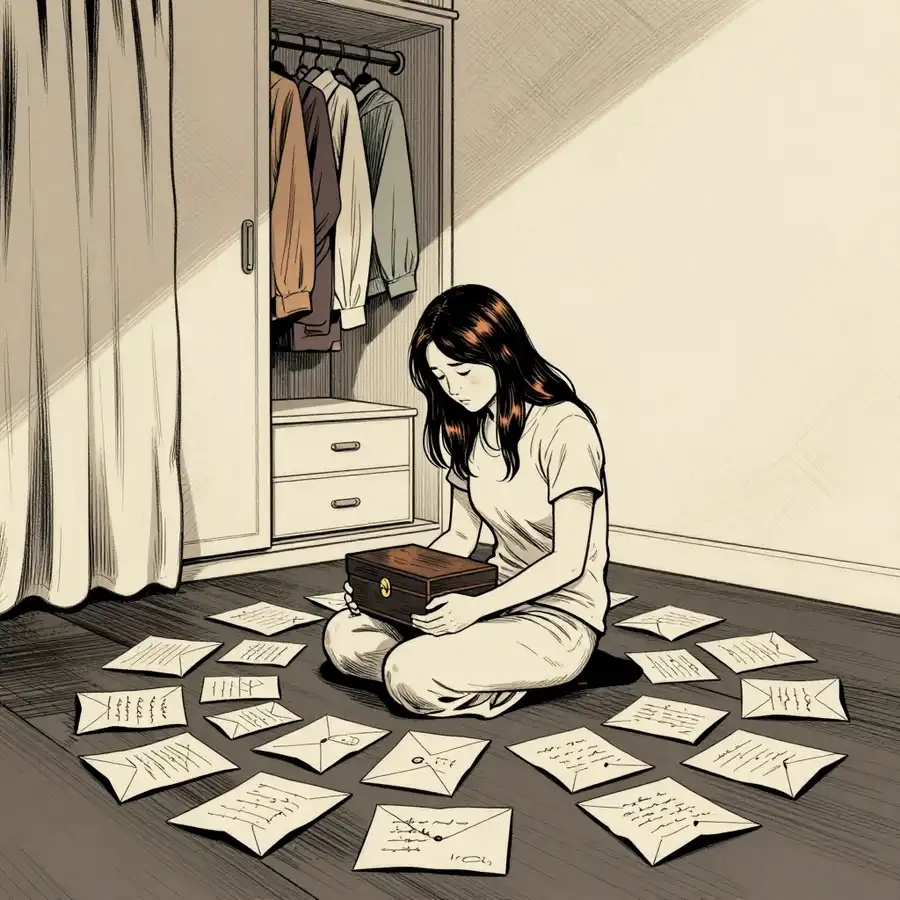
At the back of the closet, behind the winter coats and the boxes of shoes, she finds the box.
It is small. Wooden, dark, with a brass clasp that has tarnished to the color of old pennies. It does not belong in this closet. Ziqi knows this immediately, the way you know when something is out of place in a room you have memorized down to the dust patterns. Her mother did not own decorative boxes. Her mother did not own decorative anything. Every object in this apartment served a function, and if it stopped serving that function, it was discarded without sentiment. This box has no function that Ziqi can identify. It is too small for documents, too ornate for tools. It looks like something you would buy at a tourist market, something you would give as a gift to someone who liked pretty things.
Her mother did not like pretty things.
Ziqi pulls the box out and sits with it on her knees. It is lighter than she expected, as if it contains not paper but air, not words but breath. She unlatches the clasp, which opens with a click that sounds almost musical, a single clear note in the silence of the room, and inside she finds letters.
Dozens of them. Maybe a hundred. They are stacked neatly, tied with faded ribbon the color of dried roses, each envelope addressed in a handwriting she does not recognize, slanted and urgent and somehow tender. The envelopes are thin, foreign, with stamps she does not know the countries of, little rectangles of color from another world. She pulls out the top one and turns it over. The back flap is sealed with wax, red wax, stamped with a character she cannot read.
She opens it. The paper inside is thin, almost translucent, the kind of paper that tears if you breathe on it wrong, if you hold it too tightly. The handwriting is the same as on the envelope, slanted, urgent, the pen pressing so hard in places that the paper is embossed on the reverse side, as if the writer needed to carve his words into something permanent.
She reads the first line.
My Dearest Wei.
Wei. Her mother's name. Chen Wei.
Ziqi reads the letter. She reads it twice. The second time slower, as if the words might rearrange themselves into something that makes sense, as if she might have misread, as if this could be a mistake. The man who wrote this letter is in America. He is studying for a master's degree. He misses her mother with a ferocity that makes Ziqi's chest hurt, a physical pain behind her sternum. He writes about her photograph under a lamp. He writes about missing her until his body aches. He writes about love as if it is a physical force, as if it has weight and temperature and texture, as if it is something you could hold in your hands or measure with instruments.
This is not her father.
Her father was Chen Guohua. He worked in a factory that made electrical components. He died in an accident when Ziqi was five years old, crushed by a machine that should have been turned off for maintenance. Ziqi remembers almost nothing about him. A smell of motor oil. A pair of rough hands lifting her onto his shoulders. A voice singing a song she cannot recall the melody of, only the feeling of being held, of being safe. Her mother never spoke of him after his death, not in grief and not in memory. He was simply gone, erased from the apartment as thoroughly as if he had never existed, his photograph removed from the shelf, his name never mentioned, and Ziqi learned not to ask. She learned that love, in her mother's house, was something you survived, not something you celebrated.
She reaches for the next letter. The ribbon falls away, crumbling at the edges. The envelopes are not in order, she realizes, not chronological. She shuffles through them, checking dates, and finds one from October, then one from December, then one from September. She organizes them on the floor around her, a circle of paper, a ritual, a summoning, and starts again from the beginning.
He has been in America a month. He describes his classes, his roommate, the strange food that tastes like cardboard and hope. He writes about walking through campus and seeing a tree with red leaves and thinking of her because she would know the name, because she would tell him something beautiful about it that he would carry with him for years. He writes:
I am trying to become the kind of person who knows the names of trees. I am trying to become the kind of person who deserves you.
Ziqi looks up. The window has gone dark while she was reading. She did not notice the light fading. She did not notice her legs falling asleep beneath her, her back aching from sitting on the hard floor, her stomach empty and clenched with hunger she has not felt until this moment, as if her body has been waiting for permission to need things again.
She reads another. He is describing a dream. They were on a bus together, the kind that used to run between their university and the train station, and she was reading a book and he was watching her read and the bus kept driving and never arrived anywhere and he was not afraid because she was there and that was enough, that was always enough.
I woke up and reached for you*, he writes. *The bed was empty. The room was cold. I have never been so happy and so sad at the same time, and I do not know how to carry both.
Ziqi puts the letter down. She looks at the box, at the remaining stack of envelopes, at the faded ribbon coiled on the floor like something shed and abandoned. Her mother kept these letters for twenty-eight years. Her mother, who did not believe in love as anything more than a practical arrangement. Her mother, who rolled her eyes at romance novels and said "Feelings pass" as if it were a scientific law, as immutable as gravity. Her mother kept a box of love letters in her closet, hidden behind winter coats, tied with ribbon, preserved like something sacred, like something she could not bear to destroy and could not bear to look at.
She reads a fourth letter. She reads a fifth. The light in the room is gone completely now and she does not reach for the switch because the darkness feels appropriate, feels like the only possible context for what she is learning, as if light would be an intrusion, a violation. The man writes about her mother's research, her mother's students, her mother's brilliance. He reads her published papers even when he does not understand them. He is proud of her. He writes:
You are going to be remarkable. You already are.
Her mother was remarkable. Ziqi knows this. Her mother was a professor at thirty-two, a department head at forty, the kind of woman who gave lectures that students still talked about years later, who could silence a room with a single raised eyebrow. But Ziqi has never heard anyone talk about her this way, with this particular combination of awe and tenderness, as if her brilliance were not just impressive but beloved, as if her mind were something to be worshipped, not just respected.
She reads until her eyes burn and the words begin to blur on the page. She does not sleep. She does not eat. She sits on the floor of her mother's bedroom with the letters spread around her like a fort, like a barrier, like a world she has accidentally stepped into and cannot find her way out of. The man signs his name at the end of every letter. Jiaming. Just Jiaming. No surname. As if he assumed she would know who he was, as if there were only one Jiaming in the world, as if his existence were inseparable from hers.
At some point, Ziqi realizes she is crying. She does not know when she started. The tears are simply there, on her face, in her mouth, salt and exhaustion and something else she cannot identify, something that tastes like recognition. She does not wipe them away. She reads another letter, and another, and the sky outside the window begins to lighten from black to grey to the particular blue-grey of a Chinese dawn, and she is still sitting on the floor with her mother's secrets in her hands, and she does not know what any of this means except that the woman who raised her, the woman she thought she knew completely, was someone else entirely. Someone who inspired love letters. Someone who kept them. Someone who hid them in a wooden box and never spoke of them and took the secret to her grave.
Ziqi looks at the window. The first light is coming through the curtains her mother chose, beige curtains that match the beige walls, practical curtains that block the sun without being too dark. She looks at the letters scattered around her, dozens of them, each one a piece of a person her mother never showed her, a life her mother never described, a love her mother never acknowledged, and she wonders if her mother ever looked at these letters again after she put them in the box, or if she simply knew they were there, a pulse beneath the floorboards, a heartbeat in the wall.
She gathers the letters and puts them back in the box. Her hands are shaking so badly she drops one, has to pick it up, has to read the first line again just to make sure it is real. She closes the clasp. The sound is musical, final, like a door closing on a room she was never meant to enter.
She does not sleep that night. She lies on her mother's bed with the box on her chest, feeling its weight, feeling its warmth, as if the letters inside are still breathing.
我最亲爱的薇:
这里的光不一样。我一直在尝试描述有什么不一样,我一直在失败。光更薄了,或许是天空太大了,太饥饿了,把地平线都吞没了。黄昏时我坐在书桌前,把你的照片放在台灯下,让灯光落在你的脸上,就像它曾经落在你的脸上一样。那时我们一起坐在我旧宿舍的房间里。有那么一刻,我可以假装你就在我身边。我不知道一个人可以如此思念另一个人。我不知道身体会因为缺席而疼痛,就像小提琴的弦被拉得太紧时发出的那种疼痛,颤动着发出你能在牙齿里感受到的音符。我以为思念是发生在脑海里的东西。我错了。它发生在肺里。它发生在手里。它无处不在。
我的课周一就开始了。校园里种满了我叫不出名字的树。我会学习辨认它们,我会告诉你它们的故事,你会假装感兴趣,因为你就是那样的人。你总是假装对我感兴趣,为了我。我难听的音乐、我更难吃的饭菜、我在你目光已经呆滞之后还要继续解释地质构造的执念。我爱你的这些。我爱你的一切。我不是诗人。你知道的。你读过我那些失败的诗。但我正在为你尝试成为一个诗人,因为你值得拥有诗。你值得拥有一个愿意花三个小时寻找一个合适的词来描述你思考时眼睛的颜色的人。
给我写信吧。拜托。这栋楼的信箱在一楼,我每天查三次。前台的女士以为我在等成绩。我不是在等成绩。我是在等证据,证明我仍然存在于你的世界,证明我还没有变成你记忆中的幽灵。
你的,在这片太大的国度里,
佳明
1998年10月3日
葬礼是四天前的事,但悲伤不会按时到来。它先到身体里,在大脑还来不及反应时就到了。紫琪一直住在城另一头阿姨的家里,那里的空气没有妈妈茉莉花茶的味道,那里的寂静没有妈妈的形状。但今天早上她在黎明前醒来,胸口压着一种沉重的确定:她不能再拖延了。总得有人收拾这间公寓。总得有人在别人四十六年的生命中挑挑拣拣,决定什么值得留下,什么该扔掉,仿佛一个人的生命可以简化成厨房地板上的两堆东西。妈妈会希望快点做完。妈妈相信哀伤不是混乱的借口。
这栋楼是九十年代建的,正在不紧不慢地进入中年,对自己身上的裂缝越来越心安理得。电梯像个从床上爬起来的老头一样呻吟。她走楼梯。四级楼梯,被几十年的脚步磨得光滑。到达楼梯平台时大腿火烧般疼痛。身体的疼痛她能理解。身体的疼痛有规则。有边界。它不会在菜市场偷袭你,也不会藏在收音机里的一首歌里。
她在走廊里拿着钥匙站了很久,盯着门看,仿佛它自己会打开,仿佛妈妈会带着紫琪迟到时那副微微恼怒的表情出现在门的那一边。门还是那扇棕色的铁门,门框上还贴着去年春节妈妈贴的褪色对联,红纸已经变成了干涸的血的颜色。紫琪把钥匙插进锁孔。锁舌滑开的声音是她这辈子听过的最大的声音。
里面,公寓还是葬礼后她离开时的样子。黑色的挽联还挂在门把手上,从她忘记关的窗户吹来的风里微微飘动。邻居在桌上放了水果,装在塑料袋里。梨子开始发褐,橘子在自身的甜味里渗汗。妈妈的拖鞋在门口,平行摆放着,一如妈妈往常那样摆放,仿佛连鞋子都应该有条有理,仿佛通过小心排列物体就能阻止混乱。紫琪不假思索地脱下自己的鞋,踩进妈妈的拖鞋里。鞋子不合脚。太小,太窄,前主人脚的印痕还压在鞋底里。让她喉咙突然收紧,她不得不咽了两次口水。
她从厨房开始,因为厨房是最容易的房间。厨房里更多的是物体,而不是记忆,物体可以分门别类,不用带上感情。至少她是这么告诉自己的。她把一个垃圾袋塞满冰箱里过期的调料:稠到近乎固体的酱油,二十二岁搬出去之前就放在那里的泡菜罐子。她发现一盒三周前就到保质期的鸡蛋,把它拿到走廊尽头的垃圾道。那普通的重量在她手里,竟比葬礼上捧着骨灰盒更难忍受。一盒鸡蛋不知道死亡已经发生。鸡蛋只是存在着,无动于衷,等着被用掉或者扔掉,而它的无动于衷就像一种指责。她差点把它放回冰箱,就为了让什么东西还有点意义。
回到厨房,她打开灶台上方妈妈存放好茶叶的橱柜。有一罐龙井,是妈妈同事去年从杭州带回来的,还没开封,金属罐子在指间冰凉。紫琪把它放进标着"保留"的箱子里。她不喝茶。她不知道为什么要留着它。她继续往前走,因为停下来很危险。停下来就意味着感受。
客厅花的时间更长。客厅里是书,几百本书,堆在微微弯曲的书架上,木头像电梯一样呻吟。社会学和研究方法论的教科书,书脊在妈妈讲得最多的章节处被翻开裂了,页面里夹着零碎的纸条,是妈妈的笔迹。
核实这个数据
回头看看这个论据
一排字典。紫琪从没见妈妈读过的小说。她随手抽出一本,是一本言情小说,封面是一个女人穿着飘逸的裙子倚靠在一个西装革履的男人身上。它竟然在妈妈的书架上,这种荒诞感让她来不及阻止自己就笑出了声。这声音在空旷的公寓里很怪异,太响了,近乎暴力,像教堂里打碎了一块玻璃。她迅速把书放回去,仿佛自己做了什么丢脸的事,仿佛妈妈会出现,问她什么东西这么好笑。
妈妈不相信爱情,她认为爱情不过是两个理性的人做出的一个决定。紫琪知道这一点,因为妈妈反复告诉过她,在每个该说这种话的年纪,用她批改试卷的那种精准告诉她。紫琪十二岁看电视剧里谈情说爱时,妈妈坐在她旁边的沙发上说:"感觉会过去。你的教育不会。"紫琪十七岁第一次心碎回家时,妈妈给她泡了杯茶说:"六个月后你就不会记得他的名字了。这根本不重要。"紫琪二十四岁、交往两年的男友求婚时,妈妈带她去一家贵得离谱的餐厅吃了一顿饭说:"婚姻是一种合作关系。它不是一种感觉。如果你嫁给他是因为他让你有感觉,你就在犯一个错误。"
紫琪没有嫁给他。她不知道这是因为妈妈是对的,还是因为妈妈是错的。现在她永远不会知道了。这份不知道就像一块石头一样堵在她体内,咳不出来。
到了下午,她清完了客厅的书架,转移到卧室。卧室更难。卧室里有妈妈的衣服、妈妈的首饰盒、妈妈的味道。紫琪打开衣柜,茉莉花的香气猛烈地涌出来,她不得不坐在床沿上,膝盖像被剪断了线的木偶一样瘫软。床铺得如军队般精确,被子拉得绷紧,可以弹起一枚硬币,枕头拍蓬了摆在准确的位置上。妈妈最后一次去医院的那天早上铺了这张床。她是在明知道自己不会再睡在上面时铺的,但她还是铺得完美无瑕,因为那是她唯一会做的离开房间的方式。
紫琪坐在床上,看着衣柜。衣服按颜色顺序挂着,从深到浅,是妈妈生命的渐变色。她从左边开始,从黑色裤子、黑色毛衣开始,朝着浅色方向整理。一条十年前大学活动时穿的蓝裙子,还微微散发着那家餐厅的气味,她穿着它去的那家餐厅。一件红衬衫,价签还挂在上面,从未穿过,塑料标牌因为年岁已经发脆。她把每件衣服叠好放进相应的袋子里,不让自己去想那双曾经触碰这些布料的手,不让自己去想那具曾经在这些衣服里活动的身体,不让自己去想那些曾经填充它们的温度。
在衣柜最深处,在冬衣和鞋盒后面,她找到了那个盒子。
它很小。是木头的,颜色深沉,有一个黄铜搭扣,已经锈成了旧铜板的颜色。它不属于这个衣柜。紫琪立刻就知道了,就像你知道某件东西在一间你记熟了的房间里不对劲一样。细致到灰尘分布。妈妈不会拥有装饰性的盒子。妈妈不拥有任何装饰性的东西。这间公寓里每一件物品都有功能,如果不再有功能,就会被扔掉,不带任何感情。这个盒子在紫琪看来没有任何功能。它太小了装不下文件,太精致了不可能是工具。它看起来像是在旅游市场上买的东西,是那种你会送给喜欢漂亮东西的人的礼物。
妈妈不喜欢漂亮东西。
紫琪把盒子拿出来,放在膝盖上。它比她想象中更轻,仿佛里面装的不是纸而是空气,不是词语而是呼吸。她打开搭扣,那清脆的咔嗒声几乎像是音乐,一个纯净的单音符,落在房间的寂静里。里面是信。
几十封。也许有一百封。它们整齐地叠着,用褪色的丝带扎在一起,丝带是干枯玫瑰的颜色。每封信的地址都是一种她不认识的笔迹,斜的、急切的,某种无法名状的温柔。信封很薄,是国外的,贴着她不认识的国家的邮票。一个个来自另一个世界的小小彩色长方块。她抽出最上面那封,翻过来。封口上火漆犹在,红色的火漆,盖着一个她认不出是什么字的印章。
她打开信封。里面的纸很薄,近乎透明,那种你呼吸稍重就会撕破的纸。笔迹和信封上一样,斜的、急切的,有些地方钢笔按得特别紧,纸的背面都凸起了字母的印痕,仿佛写信的人需要把他的话刻进某种永久的东西里。
她读到了第一行字。
我最亲爱的薇。
薇。她妈妈的名字。陈薇。
紫琪读完了信。她又读了一遍。第二遍更慢,仿佛那些词语会把自己重组成某种有意义的东西。某种属于她妈妈公寓、属于她妈妈衣柜、属于她妈妈生命的东西。写这封信的男人在美国。他在读硕士。他用一种让紫琪胸口发痛的炽烈来思念她的母亲。胸骨后的身体疼痛。他写到了台灯下她的照片。他写到思念她直到身体疼痛。他把爱写得仿佛是一种物理力量,仿佛爱有重量、有温度、有质地,仿佛它是你能握在手里、能用仪器测量的东西。
这不是她爸爸。
她爸爸叫陈国华。他在一家制造电子元件的工厂上班。紫琪五岁时他在一次事故中去世。被一台本该停机检修的机器压死了。紫琪几乎什么都不记得了。机油的气味。一双粗糙的手把她举到肩膀上。一个声音在唱一首她再也想不起旋律的歌,只记得被抱着的感觉,安全的感觉。妈妈在他死后从来不提起他,既不哀悼,也不纪念。他就那么消失了,从公寓里被抹得干干净净,仿佛从未存在过。他的照片从架子上拿走了。他的名字再也没有被提起。紫琪学会了不问。她学会了,在妈妈家里,爱是你经历过去的东西,不是你去庆祝的东西。
她伸手去拿下一封信。丝带散了,边缘碎裂。信封不是按顺序放的,她意识到,不是按时间顺序。她翻了翻,对日期,找到了十月的,十二月的,九月的。她把信在地板上排成一个圈,纸的圈,一场仪式,一种召唤。然后她从头开始。
他到美国一个月了。他描述了课堂、室友、味道像纸板和希望的奇怪食物。他写到走在校园里看到一棵红叶子的树,想到了她,因为她一定知道这棵树的名字,她一定会告诉他一句关于树的美丽的话,让他记住许多年。他写道:
我在努力成为那种知道树的名字的人。我在努力成为配得上你的人。
紫琪抬起头。她读书时窗外已经暗了。她没有注意到光线消退。她没有注意到自己的腿已经坐麻了,背部因为坐在硬地板上而酸痛,胃里空空如也,紧缩着一种她直到此刻才意识到的饥饿。仿佛她的身体一直在等待重新需要东西的许可。
她读了另一封。他在描述一个梦。他们在同一辆公交车上,是那种曾经往返于他们大学和火车站之间的公交车,她在看书,他在看她读书,公交车一直开着却从未到达任何地方,他不害怕,因为她在那儿,那就够了,永远都够了。
我醒来,伸手去够你*,他写道。*床是空的。房间是冷的。我从来没有同时这么开心和这么悲伤过,而我不知道怎么同时装着这两样东西。
紫琪放下信。她看着盒子,看着剩下的一叠信封,看着那根褪色的丝带蜷缩在地板上,像蜕去的皮被扔在那里。她妈妈把这封信保留了二十八年。她妈妈。那个从不相信爱情只是两个理性的人做的一个决定的人。她妈妈。那个对着言情小说翻白眼、说着"感觉会过去"如同在说一条科学定律、像引力一样不可改变的人。她妈妈把一个装满情书的盒子藏在衣柜里,藏在冬衣后面,用丝带扎好,像珍藏圣物一样珍藏着。像她既不忍毁掉、又不忍面对的东西。
她读了第四封信。又读了第五封。房间里完全没有光了,她没有伸手去开灯,因为黑暗感觉很恰当,感觉是她正在了解的这一切唯一可能的语境。仿佛光会是一种侵扰,一种亵渎。这个男人写到了她妈妈的研究、她妈妈的学生、她妈妈的天赋。他读她发表的论文,即使他并不懂。他为她骄傲。他写道:
你会是了不起的。你已经是了。
她妈妈确实了不起。紫琪知道这一点。她妈妈三十二岁就当上了教授,四十岁就成为系主任,是那种能让多年后还有学生谈论的讲座的人,那种只靠挑一下眉毛就能镇住全场的人。但紫琪从未听任何人用这种方式谈论过她。带着这种又敬畏又温柔的语气,仿佛她的天赋不仅仅是令人钦佩,而是被人深爱着,仿佛她的头脑是应该被崇拜的,而不仅仅是被尊敬的。
她读到眼睛灼痛,字迹开始模糊。她不睡。她不吃。她就坐在妈妈卧室的地板上,信围在她周围像一座堡垒,像一道屏障,像一个她不小心踏入再也找不到出口的世界。每封信的末尾那个男人都签了名。佳明。就只是佳明。没有姓。仿佛他假设她一定知道他是谁,仿佛世界上只有一个佳明,仿佛他的存在和她的存在不可分割。
某个时刻,紫琪意识到自己在哭。她不知道什么时候开始哭的。眼泪就是在那儿,在她脸上,在她嘴里,盐和疲惫和某种她辨认不出的东西混在一起,一种尝起来像认出什么的东西。她没有擦去。她读了又一封,再一封,窗外天空开始亮起来,从黑色变成灰色变成那种独特的蓝灰色。中国黎明的蓝灰色。而她仍坐在地板上,手里握着妈妈的秘密。她不知道这一切意味着什么,只知道抚养她长大的那个女人,那个她以为她彻底了解的女人,是另一个完全不同的人。一个被情书倾慕的人。一个保留了情书的人。一个把情书藏在一个木头盒子里、永远不讲、把秘密带去坟墓的人。
紫琪看着窗外。第一缕光透过了妈妈选的窗帘。米色的窗帘配着米色的墙,实用的窗帘,既挡住太阳又不会太暗。她看着散落在她周围的那几十封信,每一封都是她从未见过的妈妈的一部分:一段她从不描述的人生,一份她从不承认的爱情。她想知道,妈妈把信放进盒子后,是否曾再看过它们一眼,还是她只是知道它们在那儿,如地板下的一丝脉搏,如墙里的一记心跳。
她把信拢起来,放回盒子里。她的手抖得厉害,掉了一封,必须捡起来,必须再把第一行看一遍,确认那是真的。她合上搭扣。那声音是音乐般的,是终了的,像一扇门关上了,关上一间她本来绝不该踏入的房间。
那一夜她没有睡。她躺在妈妈的床上,盒子放在胸口,感受着它的重量,感受着它的温度,仿佛里面的信仍在呼吸。