My Dearest Wei,
It has been a month and I still check the mailbox three times a day. The woman at the front desk no longer looks at me strangely. She smiles now, a small knowing smile, as if she understands what I am waiting for. I do not think she understands. I do not think anyone who has not felt this particular hunger can understand. The hunger for a specific voice, a specific name, a specific hand on the page.
I have developed a habit I did not have before. When I am thinking, I tap my fingers against whatever surface is nearest. You told me once that this habit drove you crazy, that you wanted to still my hand and hold it until I stopped. I think about this more than I should. I tap my fingers on desks, on tables, on the window of the bus, and each time I hear the sound I think of you saying my name in that particular tone you used when you were pretending to be annoyed.
I noticed something yesterday in the mirror of the bathroom down the hall. My hair has a brownish tint in this light. Not brown, exactly. Something between brown and copper, as if the sun has been stored in it. You told me once that it caught the light like copper wire. I did not believe you. I thought you were being kind, which was foolish, because you are never kind when you could be accurate instead. But I looked in that mirror and I saw what you saw. I saw the copper. I saw the sun.
I am trying to write you a poem about time zones. It is not going well. Time zones are not romantic. They are mathematical. You are thirteen hours ahead of me. I am always behind you. I am always catching up. I am always waking when you are already halfway through your day, already tired, already wondering if I will write. I will write. I will always write. Even if you stop reading, I will write, because the alternative is silence, and I have learned that silence is the only thing heavier than missing you.
Yours, in this country of too-large skies,
Jiaming
November 2, 1998
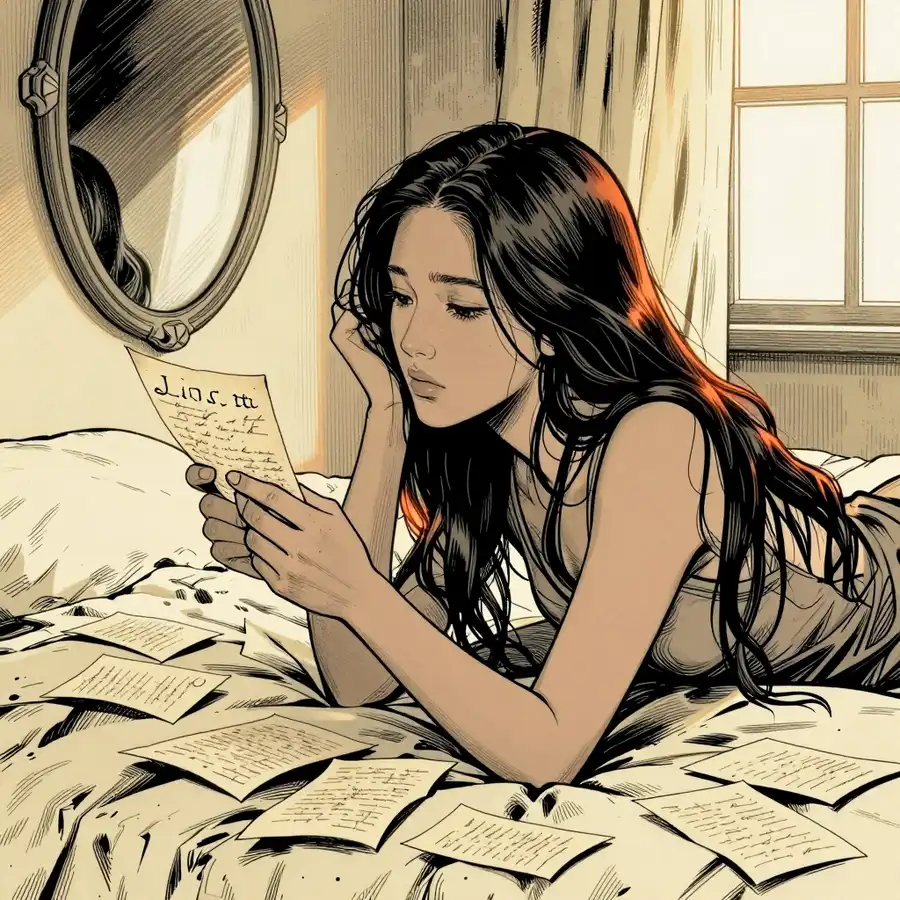
Ziqi does not go to work on Monday. She calls in sick with a voice that does not sound like her own, hoarse and hollow. She spends the day in her mother's apartment with the letters spread across the bed, reading them in chronological order, arranging them like a timeline, like evidence. Thirty-seven letters. Fourteen months. A whole life compressed into paper and ink.
She notices the parallels immediately, the way you notice a melody you have heard before but cannot place. He taps his fingers when he thinks. So does she, has done so since childhood, though her mother always stilled her hand without looking up from her grading, her touch brief and warm and somehow sad. He has a brownish tint in his dark hair. So does she, though her mother once told a hairdresser it was just the salon lighting, her voice too firm, too quick. He loves getting lost in foreign cities. So does she, though she has never admitted this to anyone, not even herself, the pleasure of being anonymous, of being unfindable.
She dismisses them as coincidence. People share habits. People share hair colors. These things do not mean anything. But she does not stop reading, and the dismissal feels like a door she is holding closed with both hands.
The tone shifts over time. The early letters are exuberant, full of exclamation marks and underlined words, the handwriting growing larger when he is excited. The later ones are confused. Hurt.
Tell me what I did*, he writes in November 1999. *I'll fix it. Whatever it is, I'll fix it. I will become someone else if I have to. I will unbecome myself.
The last letter is dated December 15, 1999. Then nothing. A silence so complete it feels like a scream. Her mother married Chen Guohua three months later.
Ziqi calls her aunt. Her hands are shaking as she dials, as if the phone itself might betray her.
"Did Mom ever date anyone? In college? Before Dad?"
A pause, long enough to hear the traffic outside her aunt's window. "There was someone. In graduate school. She never introduced him to the family."
"Why?"
"She kept him separate. Like he belonged to a different life. Like she was afraid we would contaminate him, or he would contaminate us. I asked about him once. She changed the subject so smoothly I didn't realize it had happened until the conversation was over."
Ziqi hangs up and lies on her mother's bed with the box on the nightstand. She does not open it. But she knows that everything has changed, that the floor beneath her has become a different floor, that the air in her lungs is now someone else's air.
我最亲爱的薇:
已经一个月了,我仍然每天查三次信箱。前台的女士不再用奇怪的眼神看我了。她现在微笑了,一个小小的、了然于心的微笑,仿佛她明白我在等什么。我不认为她明白。我不认为没有感受过这种特别的饥饿的人能够理解。渴望一个特定的声音、一个特定的名字、一只特定地落在纸上的手。
我养成了一种以前没有的习惯。我在思考的时候会用手指敲击最近的表面。你曾经告诉我这个习惯让你抓狂,你想按住我的手,握着它直到我停下来。我过分地想着这个。我敲击桌子,敲击车窗,每次我听到那个声音,就想起了你叫我名字时那种特定的语气,那种你假装生气时用的语气。
昨天我在走廊那头的洗手间镜子里发现了一件事。我的头发在这种光线下有一种偏棕的色调。不是完全棕,某种介于棕色和铜色之间的东西,仿佛头发里储藏了阳光。你曾经告诉我它像铜丝一样捕捉光线。我不信你。我以为你是出于好意。这很傻,因为你有更准确的说法时绝不会只是出于好意。但我朝着那面镜子里看,我看到了你所看到的。我看到了铜色。我看到了阳光。
我正在试着给你写一首关于时区的诗。进展不顺利。时区不浪漫。它们是数学的。你比我早十三个小时。我永远落在你后面。我永远在追赶。我永远是醒来的时候你已经过了大半个白天了,已经累了,已经在怀疑我是否会写信了。我会写的。我永远会写的。即使你不再读了,我也会写的,因为另一种选择是沉默。而我已经知道了,沉默是唯一比思念你更重的东西。
你的,在这片天空太大的国度里,
佳明
1998年11月2日
紫琪周一没有去上班。她用一种不像自己的声音打电话请了假,嘶哑而空洞。她一整天都待在妈妈的公寓里,把信摊在床上,按时间顺序读着,像排时间线一样排着,像理证据一样理着。三十七封信。十四个月。整个生命被压缩成纸和墨水。
她立刻注意到了那些对应,就像你注意到了一段听过的旋律却想不起在哪里听过。他思考时敲手指。她也是,从小就这样,尽管妈妈总是不抬起眼睛就按下她的手,那触碰短暂而温暖,不知为何透着悲伤。他的深色头发里有偏棕的光泽。她也是,尽管妈妈曾对理发师说那只是发廊的灯光,声音太坚决、太快了。他喜欢在异国城市里迷路。她也是,虽然她从来没向任何人承认过,甚至对自己也没有,匿名、不被找到的愉悦。
她把这些当作巧合撇开。人们会有相似的癖好。人们会有相似的发色。这些不说明任何东西。但她没有停止读下去,那种撇开就像她用两只手顶住一扇快要被冲开的门。
语气随时间流转。早期的信充满激情,满是感叹号和下划线的词语,激动时字迹越来越大。晚期的信充满困惑。受伤了。
告诉我我做了什么*,他在1999年11月写道。*我会改。不管是什么,我会改。如果需要,我可以变成另一个人。我可以不再是自己。
最后一封信的日期是1999年12月15日。然后是空白。一片如此彻底的寂静,感觉就像一声尖叫。三个月后,她妈妈嫁给了陈国华。
紫琪给她阿姨打了电话。拨号时她的手在抖,仿佛手机本身也会出卖她。
"妈妈以前和别人谈过恋爱吗?大学的时候?在爸爸之前?"
一阵停顿,长得足以听到阿姨窗外马路上车流的声音。"有一个人。读研的时候。她从没介绍给家里人。"
"为什么?"
"她让他和我们是分开的。仿佛他属于一个不同的人生。仿佛她怕我们会污染他,或者他会污染我们。我问起过他一次。她那么流畅地转换了话题,直到对话结束我才意识到已经换过了。"
紫琪挂了电话,躺在妈妈的床上,盒子放在床头柜上。她没有打开它。但她知道,一切都变了,她脚下的地板变成了另一种地板,她肺里的空气现在是另一个人的空气。