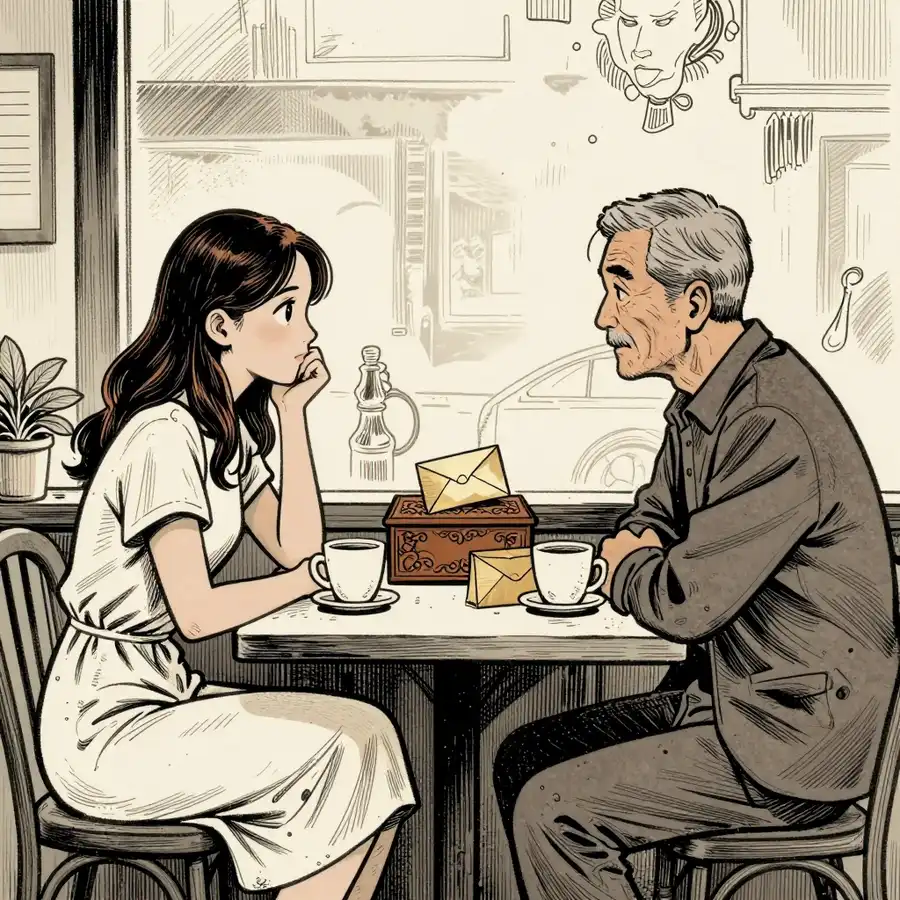
Jiaming touches the top letter gently, as if it might disappear, as if it might turn to smoke if he holds it too tightly. He picks it up. Reads the first line.
My Dearest Wei.
"I wrote this," he says, his voice barely audible, barely there. "I remember. I was sitting at my desk in Colorado, and it was snowing, and I was so lonely I could not breathe, and I thought if I could just get the words right, if I could just make her understand, she would write back. She would come back. She would remember."
He looks up. "Thank you. For finding me. For bringing her back to me, even like this. Even for a moment."
Ziqi opens her bag and takes out the wooden box again, though it is already on the table. The clasp clicks open, a sound like a heartbeat.
"She kept them," Ziqi says. "All of them. Behind winter coats. Behind boxes of shoes. Behind everything she did not want to feel."
Jiaming runs his finger along the edge of the box. "I have a box too. Cardboard. From a stationery shop on campus. Every letter she wrote me. Every single one. I have carried it with me across three countries. I have never read them without crying. I have never been able to throw them away."
He tells her about the thirty-seven letters. The early ones full of longing, of plans, of futures they drew together like maps. The later ones confused. Hurt.
Tell me what I did. I'll fix it.
He tells her about the years after, the decades of wondering, the dreams where she appears and does not speak, the mornings where he wakes up and reaches for her before he remembers.
"I never understood," he says. "One day she loved me. The next day she was cold. Then she was gone. Then she was married. Then she was a ghost. Then she was dead. And I am still here, still wondering, still tapping my fingers on tables, still checking mailboxes that will never have her name."
Ziqi looks at him. At the grey in his hair, at the lines around his eyes, at the way he holds his coffee cup with both hands as if it is the only thing keeping him steady. She thinks about the parallels she noticed in his letters. The finger-tapping. The copper in his hair. The love of getting lost. She opens her mouth to ask the question that has been sitting in her throat since she read the first letter, the question she has been afraid to give voice to.
"Were you." she starts, and stops. The words feel too large, too dangerous. "My father. Chen Guohua. He died when I was five. But before that, when you and my mother."
Jiaming goes very still. He looks at her, and she sees the moment he understands what she is asking, what she has been carrying. His eyes soften in a way that is not pity but something older, something kinder.
"No," he says gently. "No, Ziqi. We never. Your mother and I. We were waiting." He looks down at his hands, at the wedding ring he wears now, and his voice grows soft with memory. "We were both old-fashioned in that way. She used to say that some things should only happen in the life you build together, not in the life you plan. We were waiting for marriage. For the apartment with the balcony. For the ordinary mornings. We were waiting for the rest of our lives to begin."
Ziqi feels something loosen in her chest, a knot she did not know she was holding. It is relief, but it is also grief. Sharper now, somehow, because the tragedy is not that she might have had a different father, but that she might have had a different life entirely. A life built on love instead of resignation. A life where her mother smiled the way she smiled in the photographs with Meilin. A life where waiting was not a mistake.
"I think someone told her something," Ziqi says, her voice steadier now. "About Lihua. Something that wasn't true. Something that broke her trust."
Jiaming frowns. "Who?"
"Meilin. Her best friend. The person she trusted most in the world."
She tells him about the friendship that ended suddenly, without explanation. About Meilin's smooth answers, her white knuckles, her refusal to ask questions, her refusal to drink her tea.
Jiaming is silent for a long time. "Meilin. She was around sometimes. I thought..." He stops. He looks out the window at the street, at the people walking past with their own secrets, their own boxes. "I thought she had a small crush on me. Nothing serious. The way she looked at me sometimes, when she thought I wasn't watching. The way she laughed at my jokes a moment too long. I never said anything. It seemed harmless. It seemed like nothing."
Ziqi goes very still. The coffee in her cup has gone cold.
"There was something else," Jiaming says slowly, each word careful, each word heavy. "When Lihua and I were children, we used to joke about getting married. It was a game. Our parents teased us. We played along, the way children play at being grown. I might have mentioned it to Wei once, early on, when we were still telling each other everything. A funny story. A childhood memory." He shakes his head. "But what if Meilin heard it? What if she used it? What if she took a joke and made it into a weapon?"
Ziqi steps outside and dials Meilin. The wind is cold, sharp, and she does not feel it.
"It was you," Ziqi says. No greeting. No mercy. "You told her he was engaged to Lihua. You made her believe he was betraying her. You made her believe she was just a placeholder, just a phase, just something he would outgrow."
Silence. Then Meilin laughs, short and brittle, a sound like glass breaking in a distant room. "You think you understand everything? You understand nothing. You are a child playing with matches in a house full of gasoline."
"She believed you because she trusted you. Because you were her best friend. Because she loved you."
"Then she was a fool." Meilin's voice is hard, trembling, the voice of a dam cracking after decades of pressure. "She had everything and she threw it away because she couldn't stand the idea that someone else might have had him first. Because she was too proud to ask him. Because she would rather be right than be happy. That's not my fault. That's who she was."
"How would you know what she couldn't stand unless you were the one who told her? How would you know what broke her unless you were the one who broke her?"
A pause. Too long. Ziqi can hear Meilin breathing, can hear something else, something wet and suppressed. "Don't call me again."
"Meilin."
The line goes dead.
Ziqi goes back inside. Jiaming watches her face, reads it the way he used to read her mother's letters, searching for the spaces between the words.
"It was Meilin," Ziqi says. "She told my mother you were engaged to Lihua. That your families had arranged it. That she was just a placeholder, just a chapter you would close when you returned home."
Jiaming puts his face in his hands. His shoulders shake. When he looks up, his eyes are red and dry, the eyes of a man who has cried so many times that tears no longer come easily.
"I would have told her," he says. "If she had asked. If she had written one letter, one sentence, asking if it was true. I would have told her Lihua was my friend, nothing more. I would have told her I loved her, only her, always. I would have flown back that day. I would have crawled back. But she never asked. She just stopped. She just let me go. She just let us go."
"She was proud," Ziqi says, and the word tastes like her mother's tea, bitter and necessary. "She would rather suffer in silence than admit she'd been fooled. She would rather bury the love than admit it had been betrayed. She would rather build a life on a lie than face the truth."
Jiaming reaches into his bag and pulls out a cardboard box, frayed at the corners, held together with tape that has yellowed with age. He places it on the table next to the wooden one. Two boxes. Two people. Twenty-eight years of silence, finally touching.
"Her letters," he says.
Ziqi opens it. The first letter is on thin blue paper, her mother's handwriting slanting across the page in loops she recognizes from grocery lists, from notes on the refrigerator, from the careful corrections on her homework. But the words are not about groceries. Her mother writes:
I think about you at strange moments. In the middle of a lecture. Waiting for water to boil. Walking to the library. I don't know if that's love but I don't know what else to call it. I don't know what else to call the way my chest tightens when I see your name on an envelope. I don't know what else to call the way I read your letters until the ink smudges from my thumbs.
Ziqi reads another.
When you come back, we will find an apartment with a balcony. I will cook dinner and you will wash the dishes. I want that. I want the ordinary life with you. I want the boring parts. I want the mornings where we do not speak because we do not need to. I want the nights where we fall asleep with the light on. I want the middle of the story, not just the beginning.
Ziqi puts the letter down. She looks at the two boxes on the table. His cardboard one, soft and battered and held together by will. Her mother's wooden one, dark and polished and hidden. Finally together. Finally in the same room. Finally breathing the same air.
She cries. Not quietly, not prettily, but the ugly, gasping tears of someone who has been strong for too long, who has held her breath for too long, who has been carrying a weight she did not know she was carrying. She cries for her mother, for the love she lost, for the life she might have had, for the woman who taught her that feelings pass while hiding the evidence that they do not. She cries for Jiaming, for the twenty-eight years he spent wondering, for the life he built on top of a hole that never filled. She cries for herself, for the mother she never knew, for the father she barely remembers, for the family that might have been, for the ordinary life with a balcony that never happened.
Jiaming does not touch her. He sits across the table and lets her cry, his hands wrapped around his coffee cup, his knuckles white, his eyes red and wet, and she understands that he is crying too, silently, the way he has learned to cry over decades of practice, the way her mother must have cried in the dark, behind winter coats, in the space where no one could see.
The cafe continues around them. The espresso machine hisses. A child drops a spoon. The ordinary world turns, indifferent, beautiful, cruel.
Ziqi looks up. She touches the wooden box. She touches the cardboard box. She looks at Jiaming, and he looks at her, and neither speaks because there is nothing left to say that has not already been said in letters, in silences, in the spaces between words that they both understand.
The story is ending. But something else is beginning. She can feel it, a door opening in a room that has been dark for too long, a light coming through a crack she did not know was there.
She does not know what comes next. She does not know if she will stay in touch with this man who loved her mother more purely than anyone else ever had, who might become a friend, who might become a bridge to a past she never knew. She does not know if she will forgive Meilin, or if Meilin will ever forgive herself. She does not know if she will ever read all the letters, or if some mysteries are meant to remain mysteries.
But she knows this: her mother loved him. Her mother was loved. The letters are real. The love was real. And the silence is finally over. The silence that has lived in her mother's closet, in her mother's heart, in her own childhood, is finally over.
She is ready to go. She is ready to begin.
The End
佳明触碰最上面的那封信,那么轻,仿佛它会消失,仿佛他握得太紧就会变成烟。他拿起来。读了第一行。
我最亲爱的薇。
"我写了这封。我记得写它。我坐在科罗拉多的书桌前,外面下着雪。我把她的照片放在台灯下,所以光能照着她的脸。那个姿势。她偏着头,那么微微地。她是在想事情,在解决问题。问题总会解决的。她那时候是那么年轻。"
他们在咖啡店里一张角桌边面对面坐着。盒子开着,信摞在两人中间。紫琪先读了她的信。二十三封信,按时间顺序。她的妈妈,二十三岁,恋爱了。她哭了。哭得那么凶,看不清纸页。哭到她妈妈的话被眼泪弄花了。佳明没有碰她。他只是坐在那里,让她哭。
"我总是想知道她得到了什么样的生活。我希望那是一种好的生活。我希望她幸福。如果她幸福的话,那这就是我唯一需要的。这就是我能活下去的东西。"
紫琪擦了擦脸。"她是。她是我妈妈,但她不像信里的那个人。信里的那个人。她感受得那么多。但现实生活中的她,总是退缩。总是控制着。我从来没见过她哭。不是那种真正的哭。只是在电影院里鼻梁发酸。葬礼上她已经不动了。但她的书架上有一本言情小说。她把一个装满情书的盒子藏了二十八年。她感受到了一些东西。她只是不会表达。"
"你帮她表达了。这就是你正在做的事。通过你,她又成为她自己了。"
沉默。佳明看着窗外。街道很安静。海风把棕榈树吹得沙沙响。海鸥在远处的码头周围盘旋。
"我妻子让我有了一切。我爱她。我爱我的女儿们。但我心里一直有薇。不是每天都想。不足以毁掉任何东西。但有时。当太阳从某种角度照进来的时候。当我在国外的时候。当我在公交车上看一个女人读书的时候。我会想到她。我会想她过得好不好。"
"她想的。她也想到你。保持你的信。保存了二十八年。她保存它们的唯一方式就是不去看它们。太多的风险。重新打开那扇门,让她重新感觉到自己曾经的样子。但就是知道它们在那儿。我觉得那让她能活下去。心在墙里跳动。"
佳明脸皱了起来。眼泪悄悄流下来,没有声音。紫琪伸过手去。她握住了他的手。那只手粗糙,有一辈子握工具和石头的劳动痕迹。他一动不动地握了很长时间。
"谢谢你找到我。谢谢你告诉我。谢谢你带她回来。一天。一小时。对我来说够了。我从来没有过这个。我从没想过我能见到她的脸,再次,以任何形式。但在你身上,它就在那里。它就在那么近的地方。"
他们点了咖啡,但他们没有喝。凉了的杯子,凉了的过去。但桌子上的温度。他们的两盒信,他的纸板的,她的木头的,并排在一起。是没有人进来或离开时能打破的。
过了很久,他们站起来。海上的光线正在变成金色。
"你会再住一阵子吗?"
"我不知道。也许。我从来没到过新西兰。"
"留着它们。那盒信。那是你的。那一直都会是你的。但如果你想知道它们说了什么。如果你需要听到她的声音。你可以打电话给我。我可以给你读。"
他们握了手。然后,没有计划过地,他们拥抱了。那个拥抱很短,很正式,很温柔。然后他们松开了。
紫琪离开了咖啡店,走进了下午金色的光线里。她的脚步声在人行道上响亮。木头盒子在她手里。它不再重了。它不再像一个谜,像一个指责,像一道伤口。它是一件礼物。一份来自不理解爱的女人的遗赠,她感觉到的爱的深度却大到必须藏起来。紫琪在飞机上发了一条短信:"谢谢。谢谢一切。我会很快打来。"
她回到家,回到了公寓,回到了那些静默。但她是不一样的。她心里有一缕头发。铜色的,在光线下。和一个指头在思考时敲击的节奏,和一种在一个你还没来得及居住就已经属于你的世界里的归属感。
她知道这个:她妈妈爱过他。她妈妈被爱过。那些信是真的。那份爱是真的。而沉默终于结束了。那沉默活在她妈妈的衣柜里,活在她妈妈的心里,活在她自己的童年里,终于结束了。
她准备好了离开。她准备好了开始。